Chinese Checkers
Board Game, Strategy, Multiplayer · Updated
Top players this week
Ranked by wins since the start of the week. One entry per player, best run counts.
All leaderboards| # | Player | Wins | When |
|---|
No wins recorded yet this week. Play a round and you are on the board.
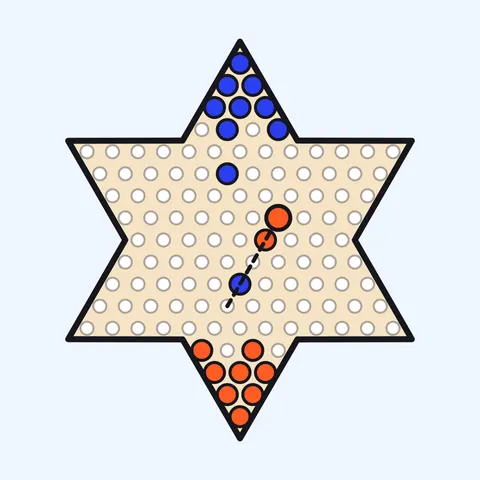
Chinese Checkers is a race across a star. Each player starts with ten marbles in one point of a six-pointed board, and the first to move all ten into the point straight across wins. You move one marble a turn, but a single marble can jump again and again, so a good turn crosses half the board. This version plays 2, 3, 4 or 6 players, against the computer or with friends on the same screen.
How to play
You are orange, starting at the bottom of the star. Your goal is the point at the top.
- Step: move a marble into any empty hole next to it.
- Jump: hop over one neighbouring marble, of any colour, into the empty hole straight beyond it.
- Chain: after a jump you may keep jumping from the new hole, in any direction, as long as each jump is legal.
You cannot mix a step and a jump in one turn, and nothing is ever captured. Tap a marble to see every hole it can reach: grey dots are steps, orange dots are jumps, and the dashed line shows the route of the last move.
For the full rules, setups for every number of players and the blocking rule, read how to play Chinese Checkers.
Players and opponents
- vs Computer: you play orange against 1, 2, 3 or 5 computer players. Choose Easy, Medium or Hard.
- Friends: 2 to 6 people share one screen and take turns, starting with orange and going clockwise.
Strategy that wins games
The fastest way across is a ladder: marbles spaced one hole apart in a line, so the marble at the back can jump over each of them in turn. Build one early, use it, then let the marble that just arrived become the next rung. Use other players’ marbles the same way, and watch for ladders you are building for them by accident.
The game is usually lost at the end, not the start. If one marble is left behind in your home corner, it needs several slow single steps on its own while the others wait. Keep your group together and the last few moves will be jumps, not steps.
Where the name comes from
Chinese Checkers is neither Chinese nor a kind of checkers. It began in Germany in 1892 as Stern-Halma, a star shaped version of the older game Halma, and picked up its American name in the late 1920s as a marketing idea. If you want the game it borrowed its name from, try Checkers; for another classic race of pieces, try Mancala.
How to get a high score
- Build ladders. A line of marbles with gaps between them lets the marbles behind jump the whole way in one turn.
- Jump over any colour. Your opponent's marbles are ladders too, so look for chains through their pieces.
- Do not leave a straggler. The last marble out of your home corner is the one that loses games, so bring it along early.
- Stay near the middle. The centre of the board has the most jumping chances; marbles along the edge get stuck.
- Fill the far end of the target corner first. Marbles that stop at the front of the corner block the rest of yours.
Questions
How do you play Chinese Checkers?
Each player starts with 10 marbles in one point of the star. On your turn you move one marble, either one step into a neighbouring hole or by jumping over a marble next to it into the empty hole beyond. You can chain as many jumps as you like. The first player to get all 10 marbles into the opposite point wins.
How many players can play?
Two, three, four or six. Two players start in opposite points, three use every other point, four use two pairs of opposite points, and six fill the whole star. Five is not a standard setup.
Can I jump over my own marbles?
Yes. You can jump over any marble, yours or another player's. Nothing is captured; the marble you jump over stays where it is.
What if a marble is blocking my target corner?
A marble that never leaves its own starting point cannot stop you. If your target corner is full and the only other marbles in it are ones still sitting at home, you win.
How strong is the computer?
Easy makes forward moves without much planning. Medium always takes the move that gets it furthest. Hard also plans its next turn, so it builds and uses ladders. In our tests Hard beat Medium in every game.
Can I play with friends?
Yes. Choose Friends and pass the device around. Everyone plays on the same screen, for 2 to 6 players. Only games against the computer count towards the wins leaderboard.